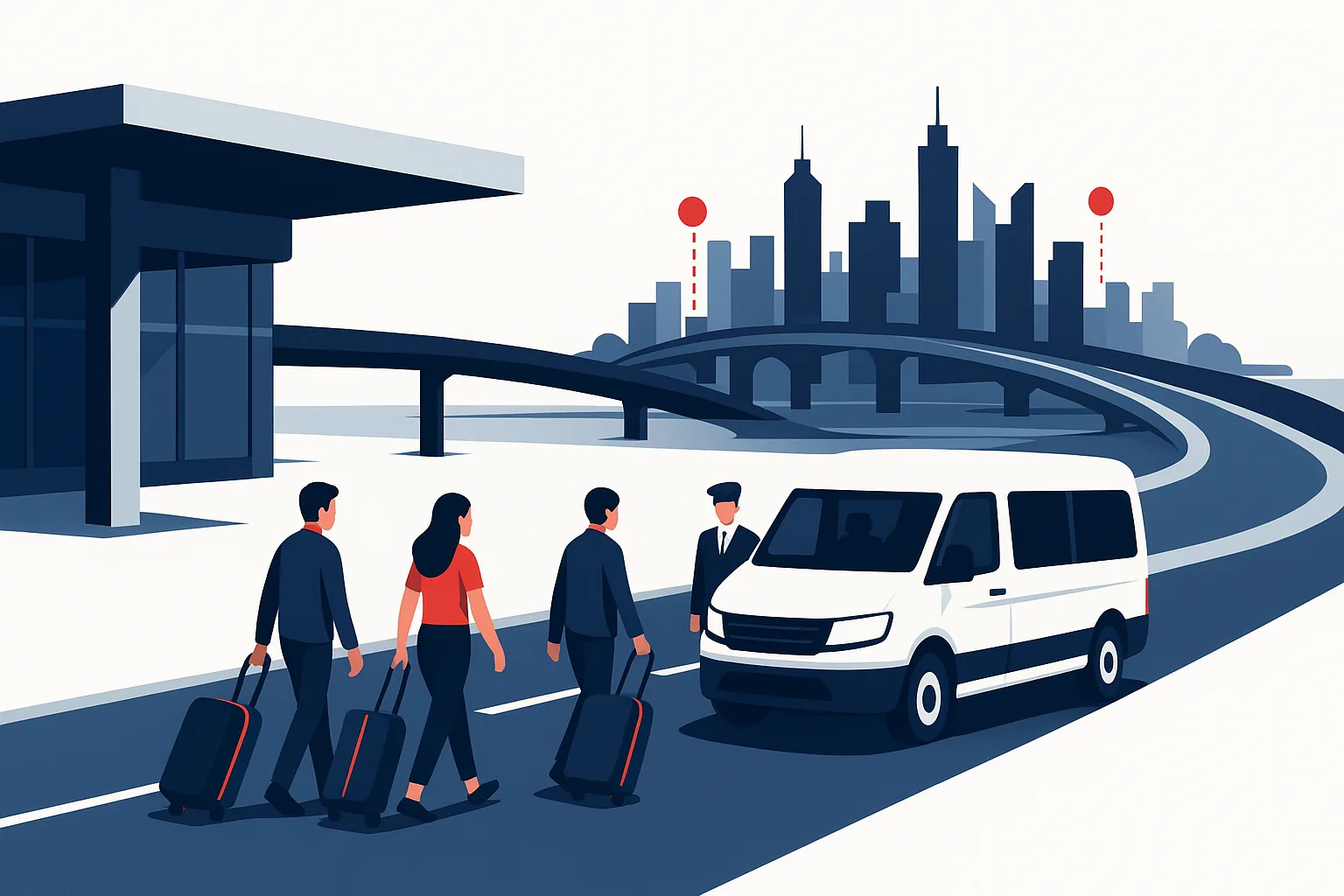


Airport Transfers for Groups and Teams — The Complete Corporate Guide
Organizing airport transfers for groups and teams is one of the most demanding logistics challenges in corporate travel. Whether you are coordinating a sales team arriving from three different cities, a delegation attending an international conference, or a group of employees relocating for a company event, getting everyone from the airport to the right place — on time and without chaos — requires real planning. This guide breaks down exactly how to do it right.
What Are Airport Transfers for Groups and Teams?
Airport transfers for groups and teams refer to pre-booked, coordinated ground transportation services designed to move multiple travelers together from an airport to a shared destination. In contrast to individual bookings, group transfers involve larger vehicles, synchronized scheduling, and centralized coordination — often managed by a travel manager or executive assistant.
These services differ significantly from standard taxi or rideshare options. Instead of each person hailing a separate car, the entire group travels together — or in coordinated vehicles — under a single booking. As a result, the process becomes far more efficient, more cost-effective, and far less stressful for everyone involved.
Who Needs Group Airport Transfers?
Group airport transfers serve a wide range of corporate and travel scenarios. Understanding which situations benefit most from this solution helps companies make smarter logistics decisions.
Corporate Teams Attending Events or Conferences
Companies regularly send teams to industry conferences, trade shows, and corporate summits. In these cases, multiple employees often arrive on different flights. However, a well-organized group transfer service coordinates all pickups under a single plan, ensuring nobody waits alone at arrivals or scrambles for a last-minute taxi.
Executive Delegations and Board Travel
Senior executives traveling together require a higher level of discretion, punctuality, and comfort. For this reason, many companies choose private group transfers over shared shuttles. The experience reflects the company’s professionalism and sets the right tone before any meeting or negotiation begins.
Employee Relocation and Onboarding Groups
When companies relocate employees or bring in new hires from abroad, group transfers provide a seamless welcome experience. Furthermore, this approach reduces the administrative burden on HR teams who would otherwise manage individual transport arrangements for each person.
Sports Teams and Media Delegations
Sports clubs, broadcast crews, and media teams travel in large groups with significant equipment. Consequently, they need vehicles that accommodate both passengers and luggage efficiently. Group airport transfer providers with fleet flexibility are essential in these situations.
Group Transfers vs. Individual Bookings — Why It Matters
Many companies default to reimbursing individual taxi receipts. On the surface, this seems simple. In practice, however, it creates hidden costs and logistical problems that add up quickly.
- Individual taxis multiply costs instead of consolidating them.
- Drivers arriving at different terminals cause coordination failures.
- Reimbursement processing consumes finance team time.
- No central record means no visibility into actual spend.
- Employees arrive at different times, disrupting event schedules.
In contrast, a pre-booked group airport transfer solves all of these issues at once. One booking, one invoice, one point of contact. Most importantly, everyone arrives together and on schedule.
Choosing the Right Vehicle for Your Team
Selecting the correct vehicle type is one of the most important decisions in planning airport transfers for groups and teams. The right choice depends on group size, luggage volume, and journey distance.
Sedans and Executive Cars (1–3 Passengers)
For small executive groups or VIP guests, a private sedan remains the gold standard. These vehicles offer privacy, comfort, and a professional atmosphere. Therefore, they work best for C-level travelers or clients who require a polished first impression.
SUVs and People Carriers (4–6 Passengers)
SUVs and MPVs serve mid-size teams well. They offer more luggage space than standard sedans while maintaining a comfortable ride. In addition, these vehicles handle airport roads and city traffic efficiently, making them a practical choice for most corporate group sizes.
Minivans and Minibuses (7–16 Passengers)
For larger teams, a minivan or minibus is usually the most cost-effective and logistically sound option. Furthermore, traveling together keeps the group connected, allows for last-minute briefings en route, and reduces the total number of vehicles needed on the road.
Full-Size Coaches (17+ Passengers)
Large corporate groups, conference delegations, or teams attending major events benefit from full-size coaches. These vehicles move an entire group in one trip. As a result, companies eliminate coordination between multiple smaller vehicles and reduce overall transfer costs significantly.
How to Coordinate Multiple Arrivals and Departures
One of the biggest challenges in corporate group travel is managing passengers arriving on different flights. Not everyone can book the same itinerary. However, a professional airport transfer service for teams handles this complexity without passing the burden back to the organizer.
Flight Tracking and Dynamic Scheduling
Reliable group transfer providers use real-time flight tracking to monitor every arrival. When a flight is delayed, the driver adjusts automatically. This means your team never lands to find an empty parking lot and no driver in sight.
Staggered Pickup Windows
For groups arriving on multiple flights within a short window, staggered pickups allow drivers to collect passengers in batches. For example, a first vehicle picks up the early arrivals, while a second vehicle waits for the later flights. This approach maximizes efficiency without forcing travelers to wait excessively.
Centralized Communication with a Single Contact
Professional group transfer services assign a single point of contact for the entire operation. Therefore, the travel manager or executive assistant communicates with one coordinator instead of managing multiple drivers individually. This dramatically reduces stress and eliminates miscommunication.
Key Features to Look for in a Group Transfer Provider
Not all transfer companies handle group bookings equally. When evaluating providers for airport transfers for groups and teams, these are the features that separate reliable services from unreliable ones.
- Fleet variety: The provider must offer vehicles ranging from sedans to full coaches.
- Flight monitoring: Real-time tracking must be built into the service, not optional.
- Fixed pricing: Group rates must be confirmed at booking, not subject to surge pricing.
- Corporate invoicing: A single invoice for the entire group simplifies accounting.
- Meet and greet option: Drivers should meet passengers inside the terminal when possible.
- 24/7 support: Travel disruptions happen at all hours. Support must be available around the clock.
- Global coverage: Companies with international teams need a provider that operates across multiple cities and airports.
Moreover, transparency matters. A trustworthy provider shares driver details, vehicle information, and booking confirmations in advance. This level of accountability builds confidence, especially when organizing high-stakes corporate travel.
Cost-Saving Strategies for Corporate Group Transfers
Budget control is always a priority in corporate travel. Fortunately, group airport transfers offer several built-in advantages that reduce costs compared to individual transport arrangements.
Volume Consolidation Reduces Per-Person Cost
When a company books one minibus instead of five separate taxis, the per-person cost drops substantially. Furthermore, fixed pricing eliminates unexpected charges from traffic delays, route changes, or peak-hour surges that affect metered taxis and rideshare apps.
Simplified Expense Reporting
Finance teams spend significant time processing individual employee transport receipts. In contrast, a single group transfer invoice covers the entire team. This reduces administrative overhead and speeds up expense reconciliation after the trip.
Negotiated Corporate Rates
Companies that travel regularly can negotiate volume-based rates with their preferred transfer provider. As a result, frequent corporate travelers access preferential pricing that further reduces the cost of each transfer. Building a long-term relationship with a single provider creates consistency, accountability, and better value over time.
How to Book Airport Transfers for Groups and Teams
Booking a group airport transfer is straightforward when you follow a clear process. Here is a step-by-step approach that works for most corporate travel scenarios.
- Confirm group size and luggage volume — This determines which vehicle category you need.
- Collect all flight details — Gather arrival times, flight numbers, and terminal information for every traveler.
- Choose your vehicle type — Match the vehicle to your group size, comfort requirements, and budget.
- Request fixed-price confirmation — Always confirm the total price before finalizing the booking.
- Share itinerary with your provider — Send all flight details so the team can monitor arrivals in real time.
- Communicate pickup logistics to your team — Let every traveler know the meeting point, driver name, and contact number.
- Request a single invoice — Confirm that billing covers the entire group under one document.
Following this process eliminates most of the common problems that derail corporate group transfers. In particular, sharing flight details early gives your provider enough time to plan for delays, terminal changes, or last-minute adjustments.
Group Transfers and Sustainability
Beyond cost and convenience, group airport transfers offer a meaningful environmental benefit. When ten people share one vehicle instead of taking ten separate cars, the carbon footprint of that journey drops dramatically. For companies with sustainability commitments, this is a concrete and measurable action.
Moreover, many corporate travel policies now include sustainability targets. Choosing group transfers over individual rides aligns directly with these goals. In addition, some providers offer hybrid or electric vehicles for group bookings, further reducing emissions on high-frequency corporate routes.
If your company tracks travel emissions, ask your transfer provider for carbon data on each trip. This information supports sustainability reporting and demonstrates genuine commitment beyond policy statements. For more on reducing your travel footprint, read our guide on how to reduce your carbon footprint when traveling.
Why Private Group Transfers Beat Shared Shuttles
Shared airport shuttles seem like a budget-friendly option on paper. In practice, however, they introduce delays, detours, and unpredictability that frustrate corporate travelers and undermine tight schedules.
A shared shuttle follows a fixed route and drops passengers at multiple stops. Therefore, a journey that should take 30 minutes may take 90 minutes when the vehicle serves several hotels before reaching yours. For teams with meetings, presentations, or events immediately after landing, this is simply not acceptable.
Private group transfers, on the other hand, go directly from the airport to your destination. No stops. No detours. No waiting for strangers to collect their luggage. The group arrives together, on time, and ready to work. For a deeper comparison, see our article on private airport transfers vs taxis.
Planning Group Transfers for International Travel
International group travel adds another layer of complexity. Customs processing, immigration queues, and connecting flights mean that arrival times vary more than domestic travel. Consequently, group transfer planning for international trips requires additional flexibility and communication.
First, always build extra time into your pickup window for international arrivals. Immigration and customs can add 30 to 90 minutes beyond the scheduled landing time. Second, confirm that your transfer provider monitors arrivals at the correct international terminal. Third, assign one team member as the local contact who communicates directly with the driver upon landing.
Furthermore, language barriers at international airports can complicate last-minute coordination. Choosing a provider with multilingual support or a clear digital communication system removes this risk entirely. The Global Business Travel Association confirms that ground transportation coordination is among the top three pain points for international corporate travel managers — a problem that professional group transfer services directly address. Learn more at the Global Business Travel Association.
Airports2Hotel — Group Transfer Solutions for Corporate Teams
At Airports2Hotel, we specialize in coordinated airport transfers for groups and teams of all sizes. Our fleet includes sedans, SUVs, minivans, and full coaches, covering airports worldwide. Each booking includes real-time flight monitoring, fixed pricing, meet and greet options, and a single invoice for your entire group. Whether you are moving a team of four or a delegation of forty, we handle the logistics so you can focus on the work ahead. Book your group airport transfer here and get an instant quote for your team.
Frequently Asked Questions
How far in advance should I book a group airport transfer?
For groups of up to 10 people, booking 48 hours in advance is generally sufficient. However, for larger groups or peak travel periods, booking at least one week ahead ensures vehicle availability and allows the provider to prepare adequately.
Can I book transfers for a group arriving on different flights?
Yes. Most professional group transfer providers accommodate staggered arrivals. Simply provide all flight numbers and estimated arrival times at booking. The provider monitors each flight and coordinates pickups accordingly.
Are group airport transfers more affordable than individual taxis?
In most cases, yes. When you consolidate a group into one or two vehicles instead of booking separate taxis, the per-person cost drops significantly. Furthermore, fixed pricing eliminates the surge charges and metered fare unpredictability that come with individual taxis or rideshare apps.
What happens if a flight is delayed?
A reliable group transfer provider tracks all flights in real time. If a flight is delayed, the driver adjusts the pickup time automatically. You do not need to call or notify the driver — the system handles it.
Can I get a single invoice for the whole group?
Yes. Corporate group transfer bookings typically include a consolidated invoice covering all vehicles and passengers. This simplifies expense reporting and eliminates the need to collect individual receipts from each team member.
Ready to Make Your Journey Easier?
Ready to make your journey easier? Let Airports2Hotel handle every detail of your group airport transfer — from flight monitoring to final drop-off. Book your group transfer now and receive a fixed-price quote in minutes. For questions or custom corporate arrangements, reach us directly on WhatsApp, by email at Support@airports2hotel.com, or follow our latest travel tips and updates on Instagram and Facebook. Your team deserves a seamless start — and we are here to deliver it.