
Knowing the right airport security tips can mean the difference between a relaxed boarding experience and a stressful sprint to the gate. Every year, millions of travelers lose valuable time at security checkpoints — not because of long queues, but because of avoidable mistakes. Furthermore, the rules around screening procedures, carry-on items, and documentation requirements continue to evolve across airports worldwide. This guide covers everything you need to know to move through airport security faster, smarter, and with far less frustration.
Why Airport Security Takes Longer Than It Should
Most security delays are not caused by the checkpoint itself. Instead, they result from unprepared travelers who slow the entire line. Understanding the most common causes of delay helps every passenger move more efficiently — and reduces friction for everyone behind them in the queue.
The most frequent issues include forgotten liquids in carry-on bags, laptops left inside cases, shoes with metal components, and boarding passes not ready for scanning. In addition, travelers wearing belts, heavy jewelry, or layered clothing consistently trigger secondary screening. Each of these situations adds minutes — and minutes compound quickly when hundreds of passengers pass through the same checkpoint.
Fortunately, every one of these delays is preventable. The airport security tips in this guide address each issue directly, giving travelers a clear action plan before they even leave home.
Prepare Before You Leave Home
The fastest path through airport security begins at home — not at the checkpoint. Travelers who prepare in advance consistently clear screening in a fraction of the time compared to those who pack without a plan.
Pack Your Carry-On with Security in Mind
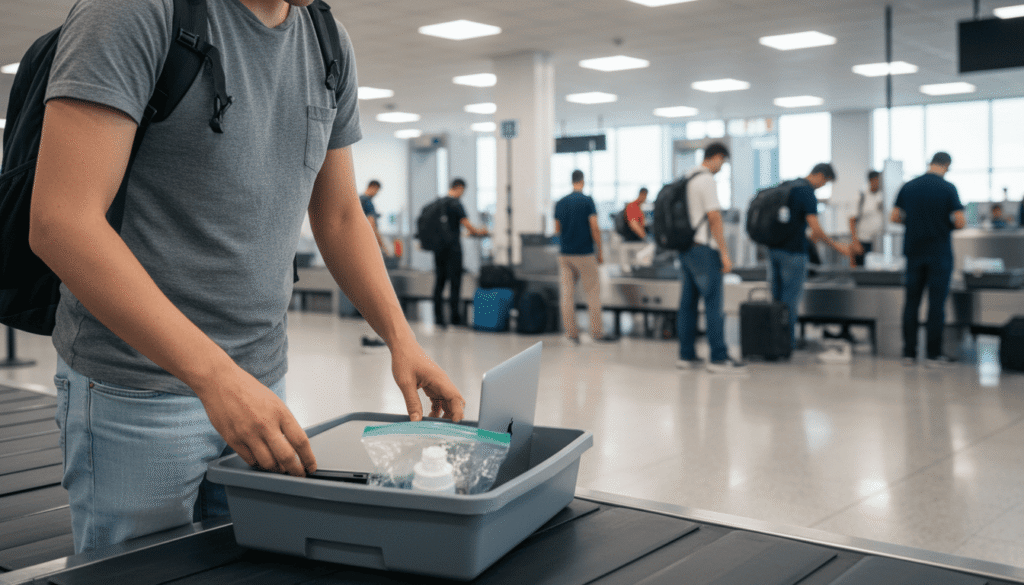
Place items that require screening — laptops, tablets, and liquids bags — at the very top of your carry-on. This means you can retrieve them instantly when you reach the conveyor belt. Moreover, keeping these items accessible eliminates the need to unpack and repack your entire bag at the tray station.
Use a dedicated small pouch for all liquids. The standard rule in most countries requires all liquids to be in containers of 100ml or less, stored in a single clear resealable bag no larger than one liter. Preparing this pouch the night before your flight removes all guesswork at the checkpoint.
Wear the Right Clothing
Choose an outfit that minimizes metal and maximizes ease of removal. Slip-on shoes save time at airports where footwear must be removed for scanning. Avoid belts with large metal buckles, heavy jewelry, and clothing with excessive metal hardware. Instead, opt for a simple outfit that passes through the scanner without triggering alerts.
Layered clothing is also worth reconsidering. Some airports require jackets and outer layers to be removed and placed in trays. Wearing a single comfortable layer reduces the number of items you need to manage at the conveyor belt.
Have Your Documents Ready
Never approach the security checkpoint without your boarding pass and identification immediately accessible. Whether you use a digital boarding pass or a printed one, have it open and ready before you join the queue. Searching through a bag or phone for documents while standing at the scanner adds unnecessary time and creates pressure for everyone waiting behind you.
Essential Airport Security Tips for the Checkpoint
Once you reach the security checkpoint, a clear sequence of actions keeps the process moving smoothly. These airport security tips apply to the vast majority of international airports and screening procedures worldwide.
Use the Trays Efficiently
Use one tray for your shoes and belt, a second tray for your laptop and tablet, and a third tray for your liquids bag and personal items. Spreading items across multiple trays prevents stacking, which slows the X-ray operator and increases the chance of a manual check. Furthermore, placing each category in its own tray makes it faster to collect everything on the other side of the scanner.
Remove Electronics Before Reaching the Belt
Begin removing your laptop and tablet from your bag while you wait in line — not when you reach the conveyor belt. This small adjustment saves 30 to 60 seconds and prevents the bottleneck that forms when travelers unpack at the last moment. Most experienced travelers develop this habit naturally after a few trips.
Empty Your Pockets Completely
Coins, keys, phones, and even small receipts can trigger the body scanner. Empty every pocket before stepping through the scanner — not after the alarm sounds. Place all pocket items into your carry-on bag or into a tray. This eliminates the most common cause of secondary screening alerts at busy checkpoints.
Follow Instructions from Security Staff
Security procedures vary between airports and countries. Therefore, always listen carefully to the instructions given by screening officers. Some airports require shoes to be removed; others do not. Some checkpoints have specific lanes for families or travelers with mobility needs. Following local instructions precisely avoids misunderstandings and keeps the process moving efficiently.
Liquids, Gels, and Aerosols — Getting It Right Every Time
The liquids rule remains one of the most misunderstood airport security requirements worldwide. However, following it correctly is straightforward once the logic is clear.
All liquids, gels, and aerosols in carry-on baggage must be in individual containers of 100ml (3.4 oz) or less. All containers must fit inside a single transparent, resealable plastic bag with a maximum capacity of one liter — roughly 20cm x 20cm. Each passenger is allowed one such bag. Containers larger than 100ml are not permitted in hand luggage, even if they are only partially full.
Items that fall under this rule include water bottles, toiletries, sunscreen, liquid foundation, mascara, lip gloss, yogurt, and even peanut butter. In contrast, solid versions of many toiletries — solid shampoo bars, solid deodorant, and powder-based cosmetics — pass through security without any restriction. Switching to solid alternatives is one of the most practical airport security tips for frequent travelers.
Medications, baby formula, and breast milk are generally exempt from the standard liquids rule in most countries. However, carry supporting documentation such as a prescription or medical letter when traveling with larger quantities.
Trusted Traveler Programs That Speed Up Security
For frequent travelers, enrolling in a trusted traveler program is one of the most impactful airport security tips available. These programs pre-screen passengers, allowing them to use dedicated fast-track lanes that bypass standard queue procedures.
TSA PreCheck (United States)
TSA PreCheck is available at over 200 US airports and with more than 100 airlines. Members use dedicated lanes where shoes, laptops, liquids, belts, and light jackets can remain in place during screening. As a result, the average wait time in a PreCheck lane is under five minutes — compared to 20 minutes or more in standard lanes during peak hours.
Global Entry (United States)
Global Entry combines TSA PreCheck with expedited US customs processing for international arrivals. It is particularly valuable for travelers who frequently enter the United States from abroad. The application process involves a background check and an in-person interview, but the time savings across multiple trips make the investment worthwhile.
Similar Programs Worldwide
Many countries operate equivalent programs. The UK offers the Registered Traveller service. Canada provides NEXUS for cross-border travelers. The European Union is expanding its Entry/Exit System, which streamlines border processing at major airports. Checking whether your home country or most-visited destination offers a registered traveler program is a worthwhile step for anyone who flies regularly.
Airport Security Tips for Travelers with Special Items
Certain items require extra preparation at the security checkpoint. Knowing how to handle them in advance prevents delays and reduces the chance of having items confiscated or flagged for manual inspection.
Electronics and Camera Equipment
Laptops and tablets must come out of bags at most checkpoints worldwide. Large cameras and camera lenses may also require separate screening. Pack all electronics where they can be retrieved quickly. Furthermore, power banks and lithium batteries must travel in carry-on luggage — they are not permitted in checked baggage according to most international aviation safety regulations.
Food and Snacks
Solid food items generally pass through security without issue. However, liquid or gel-like foods — including soups, jams, hummus, and soft cheeses — fall under the liquids rule. If you are carrying homemade food or specialty items, place them at the top of your bag for easy inspection. In addition, be aware that certain food items cannot cross international borders due to agricultural restrictions.
Medical Devices and Implants
Travelers with pacemakers, insulin pumps, joint replacements, or other implanted medical devices should inform security staff before screening begins. Most airports have alternative screening procedures for passengers who cannot pass through standard body scanners. Carrying a medical device card or letter from a doctor significantly speeds up this process.
Traveling with Accessibility Needs
Travelers with mobility needs, wheelchair users, and passengers who require additional assistance are entitled to dedicated support at security checkpoints in most international airports. Contact your airline in advance to arrange assistance, and arrive with additional time to allow for a comfortable screening experience without pressure.
How to Handle a Secondary Screening Calmly
Even well-prepared travelers sometimes face secondary screening. This is a routine procedure and does not indicate that anything is wrong. Remaining calm and cooperative is the most effective approach.
During secondary screening, an officer may use a handheld scanner, conduct a pat-down, or open and inspect a specific bag. The process typically takes three to five minutes. Afterward, the traveler is free to continue to the gate. If an item is flagged and confiscated, officers will explain the reason and in most cases offer the option to place the item in checked baggage before the flight.
To minimize the likelihood of secondary screening, follow all the airport security tips in this guide before arriving at the checkpoint. Additionally, avoid wearing bulky clothing, limit the number of electronic devices in your carry-on, and always remove metal items before stepping through the scanner.
Arriving at the Right Time Makes Everything Easier
No collection of airport security tips replaces the simple advantage of arriving early. Most international airports recommend arriving at least two to three hours before departure for international flights and 90 minutes for domestic flights. This buffer accounts for check-in, baggage drop, security, and the walk to the gate.
Peak security hours typically align with early morning departures between 6am and 9am, midday business travel surges, and late afternoon leisure travel. If your schedule allows flexibility, booking flights that depart outside these windows reduces queuing time significantly. Moreover, traveling on weekdays rather than Fridays and Sundays generally means shorter checkpoint lines at most major airports.
According to the Airports Council International, peak-hour congestion at major hubs adds an average of 18 to 25 minutes to the pre-flight process for unprepared travelers. Planning around these windows — combined with the airport security tips in this guide — makes a measurable difference to your overall experience. For more details on global airport passenger flow data, visit Airports Council International.
Plan Your Full Airport Journey with Airports2Hotel
Getting through security faster is just one part of a smooth travel experience. How you arrive at the airport matters just as much. A pre-booked private transfer ensures you reach the terminal relaxed, on time, and fully prepared — rather than rushed after navigating public transport with heavy luggage. Explore our full range of airports and travel tips for practical guidance covering every stage of your journey, from departure to final destination.
Ready to Make Your Journey Easier?
Ready to make your journey easier? Start your trip the right way with a pre-booked airport transfer from Airports2Hotel — so you arrive at the terminal calm, on time, and fully prepared for a smooth security experience. Book your airport transfer now and get a fixed-price quote in seconds. For personalized help or group bookings, reach us on WhatsApp, by email at Support@airports2hotel.com, or follow our latest travel content on Instagram and Facebook. Your journey deserves a great start — and we are here to make sure it gets one.